Rhythm problems
Twice a year, our bodies have to go through something that scientists call "mini-jetlag": the time change. Learn here what effects this can have on your health and discover how you can cope with the time change more easily.

When the clocks are set forward one hour in spring and set back one hour in autumn, your biorhythm can get out of sync.
The switch to daylight saving time in spring is particularly difficult, as we lose an hour of sleep, which often takes days to weeks to recover from. In particular, night owls, or late chronotypes, suffer. They experience longer-lasting side effects, as the new time aligns even less with their internal clock compared to larks. The consequences can be compared to jet lag [1].
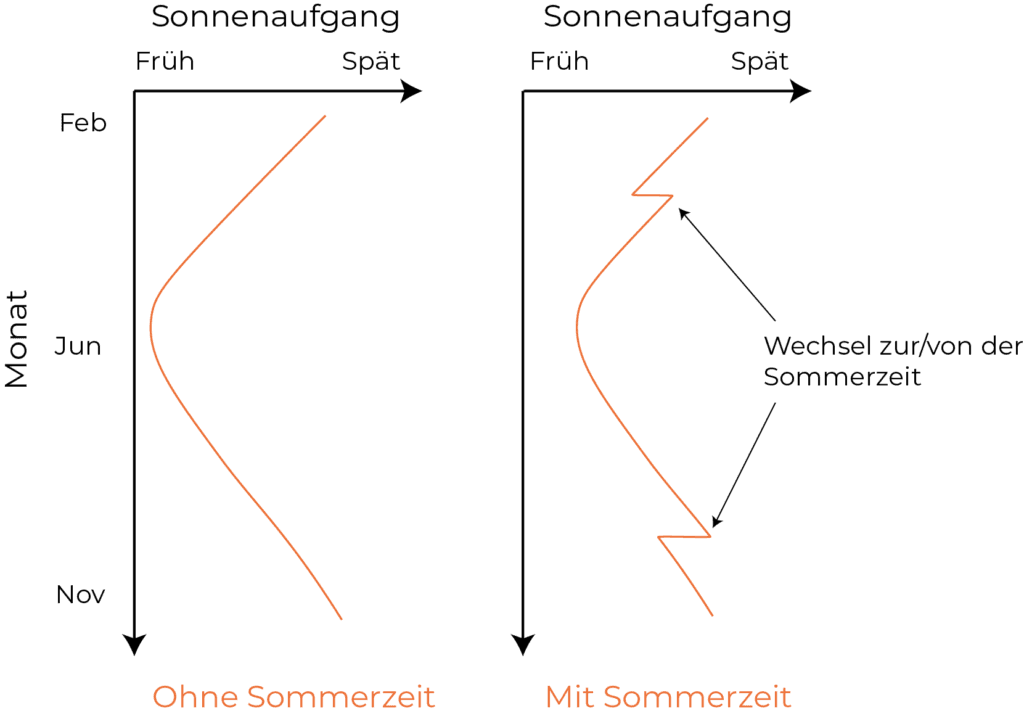
The switch to daylight saving time or standard time disrupts the natural course of sunrise with the clock time. Thus, our physical adaptation to light conditions is disturbed. [1]
Studies show that setting the clocks back in autumn causes fewer problems [1]. According to experts, this is because the internal clock of most people is already lagging behind.
Effects of Time Change on Health
The most common consequences of the time change are fatigue and depression, which can last for days to weeks in sensitive individuals. Your internal clock determines what your body and brain do at what time of day. If this is disrupted, problems can arise that affect mental health and bodily functions [2]. For example, several studies have shown that the rate of heart attacks increases in the days following the transition to daylight saving time. On the Monday after the time change, it was reported in one study to be a full 24% higher than in other weeks [3]. The number of traffic accidents also rises – and sadly so does the suicide rate [4,5]. Other studies provide less definitive results [6], but overall it seems clear that the time change has health effects.
But not only that, our cognitive performance and concentration can also be negatively affected by the time change. Employees tend to engage in "cyberloafing" – doing other things online at work instead of their actual job – shortly after the switch in spring [7]. A study of American students yielded even more dramatic results: In states where daylight saving time is regularly observed, students perform worse in standardized tests [8].
Our Checklist for the Transition to Daylight Saving Time
How can you best cope with the transition to daylight saving time? A few simple measures can make a big difference. The following guide will show you how to master the weekend of the time change by moving your internal clock forward.
Saturday
Go outside as soon as you get up.
Spend at least an hour outdoors in the morning, for example, in the garden or taking a walk in the park.
If you exercise, do it in the morning or early afternoon, but not later.
Have dinner half an hour earlier than usual.
Avoid artificial light sources as much as possible two hours before bedtime. If that's not possible, reduce the brightness to a minimum – candles are allowed.
Sunday
Go outside as soon as you get up.
Spend at least an hour outdoors in the morning, ideally with physical activity (e.g., running, cycling, walking). This not only helps adjust your internal clock but also supports you in falling asleep well in the evening despite the earlier time.
Eat your meals according to the new clock times. Especially avoid a late dinner.
Minimize artificial light in the evening. An offline evening, such as with a warm shower or bath one hour before bedtime, can help you fall asleep better.
Generally, the earlier you start moving your bedtime forward, the easier the transition will be.
If you typically react strongly to the time change, you should drive as little as possible in the first few days and avoid dangerous activities. This way, you can avoid the increased risk of accidents during this time.
Why Do We Even Change the Clocks?
Why was daylight saving time introduced by politicians? The English name reveals it: "Daylight Saving Time" – to extend daylight hours and ultimately save energy. In 1996, daylight saving time was standardized by the EU, so now all member states set their clocks forward on the last Sunday in March and back on the last Sunday in October. Around 70 countries are trying to save energy through this measure. However, even this main reason for daylight saving time is now controversial: The German Federal Environment Agency has found that the energy-saving effect is negated by the heating required in the early morning hours [9]. Many researchers advocate for the abolition of daylight saving time. In 2018, the issue gained attention through an EU-wide online survey: 84% of approximately 4.6 million responses favored abolishing it. The EU responded with the decision to carry out the time change one last time in 2021 and leave it to member states whether to remain in standard time or daylight saving time [10]. Thus, the clocks were supposed to have been changed for the last time in March or October 2021. However, some governments, such as the German one, insist on a prior investigation by the European Commission. An impact assessment is essential before such a far-reaching decision. However, the Commission refuses to provide this. Therefore, it will likely still take some time before our clocks are changed for the last time [11].